


Fundamentals: Shapes & Forms
The 2D-to-3D Foundation Behind Complex Drawings
Good paintings start with good drawings, and a core drawing fundamental is shapes and forms. While shapes and forms are closely related, they are crucially different because shapes are two-dimensional while forms are three-dimensional.
On the 2D side, the basic shapes are:
Circle
Rectangle
Triangle
When depth is added (on the Z axis), each of these shapes become a 3D form. As Clint outlines in the video, forms are combinations of 2D shapes, stacked or combined into volumes:

Forms are 3D volumes that are combinations of 2D shapes
For example:
A circle plus itself becomes a sphere. Slice a sphere any way you want and the cross-section will be a circle.
Attaching squares to right angles of itself becomes a cube. Viewed from every orthogonal view it’s still a square.
Attaching triangle to itself becomes a triangular pyramid.
Once you begin to look at combinations of shapes, forms multiply.

For example:
Circle + Rectangle = Cylinder. Seen from the top, a cylinder reads as a circle. Seen from the side, it reads as a rectangle.
Circle + Triangle = Cone. From the top it reads as a circle, and from the side it reads as a triangle.
Square + Triangle = Pyramid. Each top face is a triangle but viewed from the bottom it's a square.
While pyramids and the torus (like a doughnut) can be considered as base forms by our reasoning, they are not typically included as a “primary form” because they are less common in the natural world and in everyday construction.
So for our purposes, the primary forms are: sphere, cube, cylinder and cone.

Why shape & form matters to your art
The key skill related to shapes and forms is being able to see them as the basis of real-world subjects and use them as building blocks to construct a piece.
Often, the final subject can look complex because of surface detail, so the artist’s job (especially early in a drawing) is to ignore the details, identify the basic underlying forms, and block that in. Complexity becomes manageable when the base structure is understood first. Use forms to give your initial sketch believable volume and depth before adding in smaller details.
This is key for Illustrators and concept artists who often need to create subjects without direct reference, and that’s where the importance of form or volumetric thinking and drawing really shines. By understanding forms well enough to “rotate them and hold them” mentally, you’ll be able to combine them into new structures that still feel consistent and believable.
Using this in practice
The basic workflow follows a consistent pattern: identify the forms, block them in, then build detail on top. Large to small forms.
1) Reduce everyday objects into primary forms
Everyday objects can be reduced to a few simple forms to help block a scene.

An ice cream cone breaks into two clear forms: the scoop as a sphere and the cone as a cone (obviously).

1) A wooden desk can be simplified into a collection of boxes by ignoring the details.
2) By understanding the underlying form, we can then more easily reorient the subject if desired.
The important part of these examples is building the habit of seeing past details and choosing a simple form that defines the object’s volume.
2) Simplify architecture into big forms first
Even intricate architecture can be reduced to a few solids.

As students cover in the Form Drawing course, learning to accurately recognize and draw the basic forms of buildings is critical before any details or shading is added. In the case of this tower, the structure can be simplified into a handful of cylinders and angled boxes.

This principle builds directly into the next step of shading and rendering. In Form Rendering students must practice both being able to draw the primary form version of buildings, and correctly shade those forms.
3) Nature also follows basic forms
Natural structures often fit the same primary forms.

A tree trunk and branches read as cylinders. The canopy of a tree can often be interpreted as a large sphere-like mass. Basic forms are not an artificial drawing tool. They are a way to describe the underlying structures that commonly occur.
4) Apply the same thinking to the human figure
Figures can feel intimidating to draw because the forms blend together under the skin, but you can build with the same or modified basic forms.
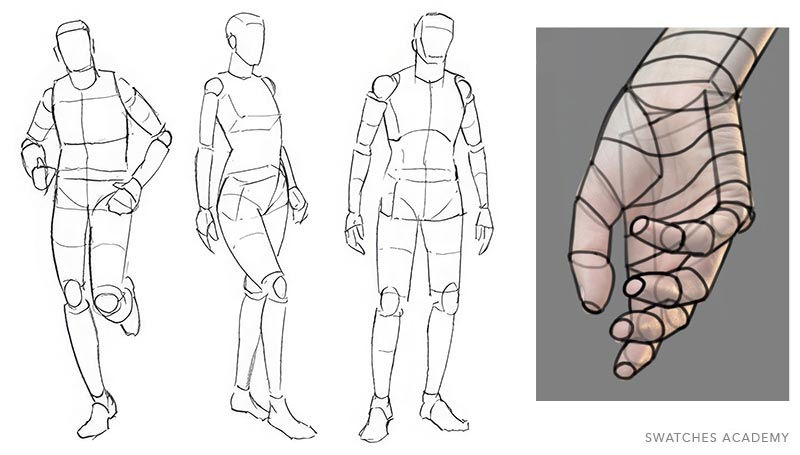
The human figure can be expressed as a collection of modified boxes, cylinders, and spheres. These forms capture the volume and orientation of the subject, and because they aren't being bogged down with details, they are much easier manipulate and create from imagination.
The point is not that anatomy is literally made of perfect primitives, but that primitives provide a starting structure that can later be detailed and shaded.
Learn forms well enough to mentally rotate them
After recognition comes manipulation. Your first goal in this subject should be to understand forms so they can be rotated, tilted and spun in your mind and art without you requiring reference.

A sphere changes very little when rotated, but cubes, cylinders and cones visibly change based on angle and orientation. Take time to practice drawing rotated versions of simple forms. It’s a useful way to build this key mental skill and will set you up for constructing any type of new object.
Student takeaway
Detail becomes easier to manage when it sits on top of a clear 3D foundation, and imaginative scenes without direct reference are dependent on the artist's ability to conceptualize and render in volumes. Improve your digital art by: practice recognizing the forms, placing them, then refining with smaller details and shading.
Related Swatches Academy Classes
If you’re interested in taking your digital drawing and painting further, Swatches Academy offers self-guided courses to help you do your best work. Here’s a few related to this topic:
Digital Painting Basics - if you're new to digital painting and need to both learn how to use Photoshop, and learn foundational art principles
Form Drawing - if you need to improve your ability to think and draw in volumes. Note: SAVE $30 on Form Drawing during March 2026
Form Rendering - if you can draw volumetrically but need to improve the accuracy and believability of your shading and painting



Comments